Mobile devices changed digital marketing by making online discovery, content consumption, shopping, communication, and measurement available throughout the day instead of mainly during desktop sessions. The biggest effect is not one new marketing channel; it is a customer journey that increasingly crosses small screens, apps, websites, search engines, social platforms, and sometimes multiple devices.
Quick Take
Mobile-first marketing means designing discovery, content, landing pages, conversion paths, and measurement around how people actually use phones. It does not mean ignoring desktop users, and it does not guarantee that every audience behaves primarily on mobile.
That distinction matters because mobile access is now enormous without being universal or exclusively dominant. The GSMA’s State of Mobile Internet Connectivity 2026 reports that 4.8 billion people, or 59% of the global population, used mobile internet by the end of 2025. At the same time, device use still varies by market, task, audience, and stage of the buying journey.
Mobile Turned Internet Access Into an Always-Available Environment
Before smartphones became widespread, many online activities depended more heavily on sitting at a computer. A person might check email, search for a product, visit several websites, and then leave those online tasks behind when stepping away from the desktop. A phone changes that pattern because search, social media, messaging, video, shopping, maps, and websites can all be available from the same device throughout the day.
That change gives digital marketers more possible moments of contact with customers. Someone can discover a restaurant while walking through a city, compare prices from inside a store, open a promotional email on a bus, watch a product demonstration in a social feed, or return to an ecommerce cart later that evening.
The scale of mobile internet helps explain why those interactions matter. GSMA’s 2026 connectivity report says 4.8 billion people used mobile internet by the end of 2025, while 3.4 billion people still did not. A large share of those non-users already live within mobile broadband coverage, showing that network availability alone does not mean everyone is online.
The practical lesson is to examine the audience being served. A campaign aimed at urban smartphone users in one country may have a very different device mix, connection quality, and customer journey from one aimed at business buyers, older consumers, or customers in a region where device cost, mobile-data affordability, awareness, or digital skills remain barriers.
| Mobile-driven change | Marketing consequence | What marketers need to watch |
|---|---|---|
| Mobile-first discovery | Search results, social feeds, maps, apps, and mobile links can become entry points to a brand. | Content availability, discoverability, and the quality of the destination page. |
| Small-screen browsing | The post-click experience can affect whether someone continues, abandons, or converts. | Loading, responsiveness, readable layouts, and usable controls. |
| App-based interaction | Businesses may gain additional direct contact points through apps and permitted notifications. | User permission, relevance, interruption, and platform rules. |
| Cross-device journeys | One customer’s activity may be divided across multiple sessions or devices. | Reporting identity, attribution, and duplicated or incomplete user counts. |
| Privacy controls | Some advertising and analytics signals are unavailable unless conditions such as consent are satisfied. | First-party data, modeled results, platform restrictions, and measurement gaps. |
Mobile Changed Search and Content Discovery
A common mobile journey begins with a simple action: someone searches for an answer on a phone and opens one of the results. That makes the mobile version of a website important not only for the person using it, but also for how Google understands the page.
Google calls this mobile-first indexing. Google uses the mobile version of a site’s content, crawled with its smartphone agent, for indexing and ranking. Google also recommends responsive web design because it can serve the same HTML on the same URL while adapting the presentation to different screen sizes, making that configuration comparatively straightforward to implement and maintain.
Mobile-first indexing does not mean creating a thin mobile page with less useful information. Google advises sites with separate mobile and desktop experiences to keep their primary content equivalent. Important headings, images, structured data, titles, descriptions, and other material should not disappear simply because the screen is smaller.
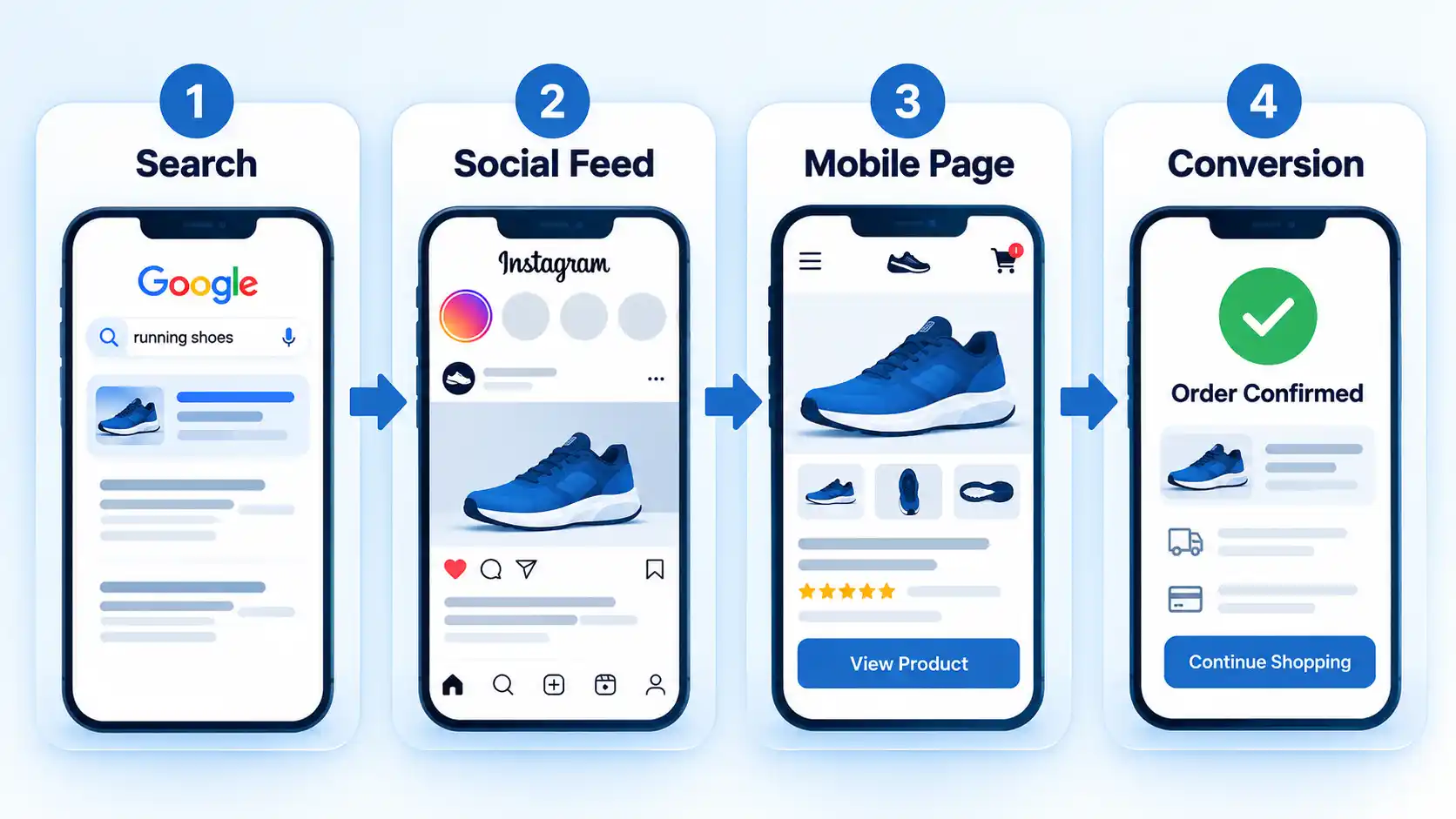
Search is only one discovery route. A customer can also encounter a brand through a social feed, a shared link, a video, a map result, or an app. For example, an Instagram marketing strategy can connect content discovery and audience engagement to a measurable business goal instead of treating likes or follower counts as the final outcome.
This creates a broader marketing problem than simply ranking well in mobile search. The landing destination has to continue the promise made by the search result, ad, post, email, or app message that brought the visitor there.
For teams that need to turn that broader principle into an operating plan, a mobile marketing strategy built around the customer journey can connect discovery, landing experience, conversion, and measurement instead of treating every mobile channel separately.
Small Screens Made User Experience Part of Marketing Performance
Imagine that an advertisement works exactly as intended: the right person sees it, understands it, and taps it. The campaign can still fail if the destination takes too long to load, the text is difficult to read, the main button moves unexpectedly, or a full-screen overlay blocks the page.
This is why mobile marketing cannot end at the ad or search result. The experience after the click is part of the same journey. A responsive layout should adapt to the available screen, navigation should remain usable, important controls should be easy to interact with, and the main content should not be buried under intrusive elements.
Google’s page experience guidance asks site owners to consider whether pages display well on mobile devices, avoid intrusive interstitials and excessive distracting advertising, use secure delivery, and make their main content easy to distinguish.
Performance also has measurable components. Core Web Vitals are Google’s metrics for important parts of real-world page experience. Google’s current Core Web Vitals guidance identifies three metrics:
- Largest Contentful Paint (LCP) measures loading performance. Google’s “good” target is within 2.5 seconds.
- Interaction to Next Paint (INP) measures responsiveness after interaction. Google’s “good” target is less than 200 milliseconds.
- Cumulative Layout Shift (CLS) measures unexpected visual movement. Google’s “good” target is below 0.1.
These metrics are useful, but they should not be treated as a magic ranking formula or a guarantee of conversions. Google says there is no single “page experience signal,” and good Core Web Vitals do not guarantee a top position in Search. A fast page can still fail if it gives the visitor the wrong information, while an attractive page can still perform poorly for users if it loads slowly or responds badly on their actual connections.
A deeper mobile search engine optimization (SEO) and smartphone testing checklist is useful when the job changes from understanding these principles to diagnosing specific rendering, responsiveness, content-parity, or Core Web Vitals problems.
Mobile Expanded Direct, App-Based and Contextual Marketing
A normal website usually waits for someone to return. Mobile apps can add other contact points because an installed application may support account activity, in-app messages, saved preferences, or notifications when the user has granted the required permission.
Mobile devices also make other established channels more immediate. Email can be opened moments after delivery. Social content can be encountered throughout the day. A customer can move from a message or feed directly to a product page, map, booking interface, or checkout without changing devices.
That does not make every mobile contact valuable. A notification that arrives too often can be ignored or disabled. An email that looks good on a desktop can still be difficult to use on a narrow screen. A social post can generate attention without producing a meaningful business result. The channel provides an opportunity for contact, not proof that the contact is effective.
Phones can also provide contextual signals that stationary desktop experiences do not always offer as naturally. Location is an obvious example. Where user permission, platform rules, and applicable privacy requirements allow it, location information can support experiences such as local search, directions, nearby availability, or geographically relevant messaging.
The important qualifier is permission. Having an app installed or having access to advertising technology does not create unrestricted rights to observe a person’s device or use every available signal. Mobile marketing has developed alongside increasingly explicit controls over what apps and advertising systems can collect and connect.
The Customer Journey Became Cross-Device
A person who starts on a phone does not always finish there. Someone might tap an advertisement during lunch, research the product on a smartphone, return on a laptop after work, and complete a purchase later. If an analytics system treats each device as a completely unrelated user, the journey can become fragmented in reporting.
Attribution is the process of assigning credit for a result, such as a purchase or lead, to marketing interactions associated with it. Cross-device behaviour makes attribution more difficult because the interaction that introduced the customer and the interaction where the conversion occurs may happen in different sessions and on different devices.
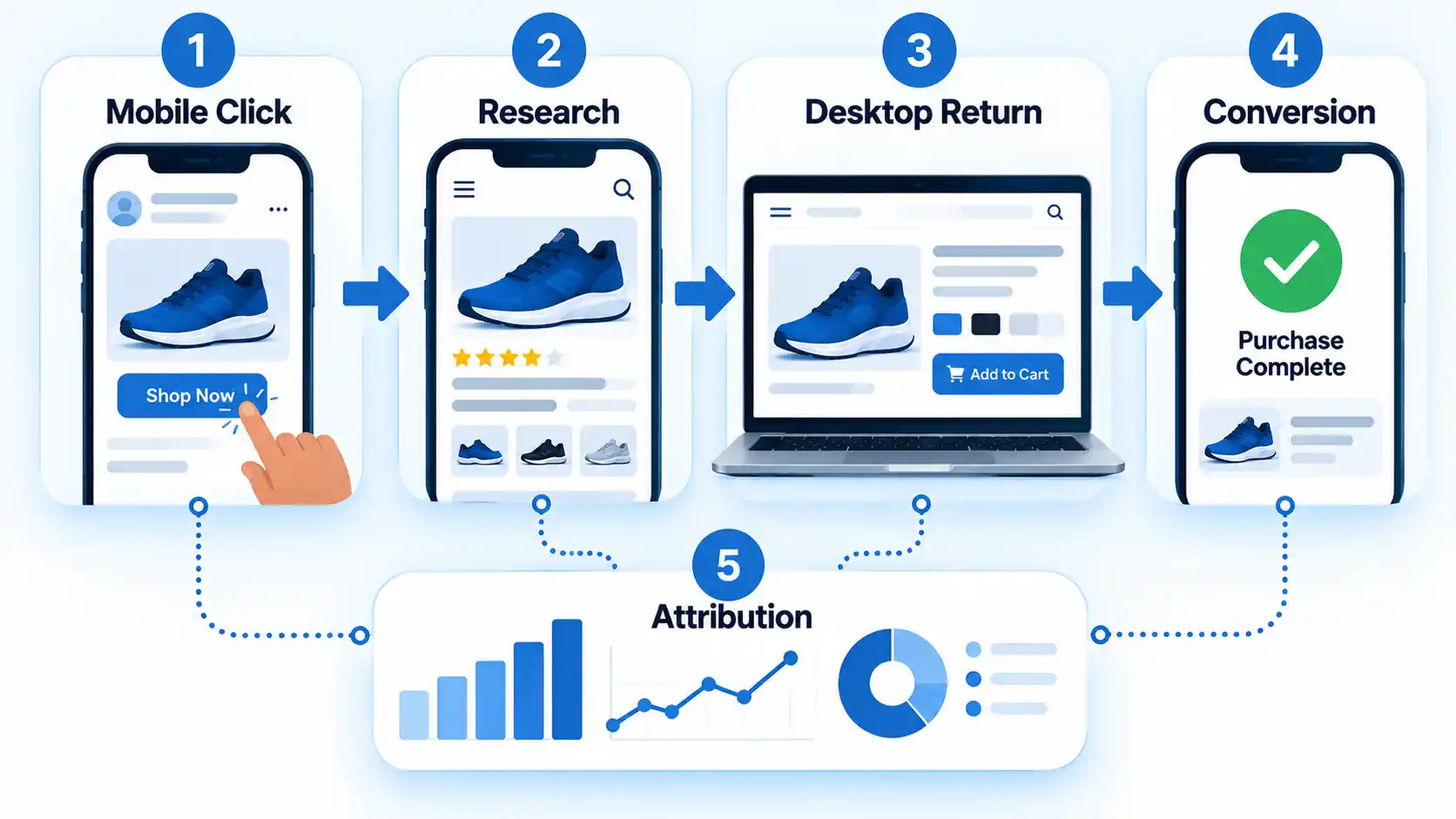
Google Analytics 4 illustrates the problem through what it calls reporting identity. Its reporting identity documentation explains that Analytics can use User-ID, device ID, and, under its blended option, modeling to create a more unified view of activity across devices and platforms.
A User-ID is a persistent identifier that a business creates and sends for signed-in users. When it is assigned consistently, the same identifier can help connect activity across different sessions and devices. A device ID is a pseudonymous identifier associated with a browser or app installation. Modeling can estimate some activity when identifiers or directly observable events are unavailable.
Those methods have limits. Google itself gives the example of two different people using the same User-ID and therefore appearing as one user in Analytics. People who are not signed in may also be harder to connect across devices. Modeled data estimates patterns in activity that cannot be directly observed; it should not be read as a reconstructed diary of what one identifiable individual did.
The practical consequence is that device reports need interpretation. A marketer may see one session on a phone and another on a desktop even though both belong to the same buying journey. Conversely, an identity system can combine activity when a login or account is shared. Measurement becomes more useful when the team understands what each identity method represents and where uncertainty remains.
Teams working deeply on this problem may also need to compare cross-device attribution with device-based analytics so they know when reports describe devices, sessions, modeled behaviour, or connected signed-in journeys.
Mobile Privacy Changed What Marketers Can Measure
Mobile devices created more measurable digital interactions, but they did not create unlimited visibility. Privacy controls can prevent an advertiser or analytics provider from observing or connecting some of the signals that older measurement approaches expected to have.
Apple’s App Tracking Transparency (ATT) framework is one clear example. Apple defines tracking in this context as linking user or device data collected in one company’s app with data collected from other companies’ apps, websites, or offline properties for targeted advertising or advertising measurement, as well as sharing certain data with data brokers.
According to Apple’s privacy and data-use documentation, apps on supported Apple operating systems need permission through ATT before tracking a user as defined by the framework or accessing the device’s advertising identifier for that purpose. Without that permission, the advertising identifier is unavailable and the app may not track the person in the ways covered by ATT.
This does not mean that every form of analytics disappears or that every business loses the same information. It means marketers should distinguish information they directly observe from information a platform estimates, models, or cannot connect because of privacy and technical limitations.
Google Analytics, for example, states that modeling can estimate activity that cannot be observed directly when identifiers or measurable events are unavailable. Its guidance on modeled key events lists privacy controls, technical limitations, and cross-device journeys among situations where modeling may be used.
First-party data has consequently become important to some measurement systems. First-party data is information a business collects through its own direct relationship with a customer rather than obtaining it from an unrelated outside source. Google Ads’ enhanced conversions documentation, for example, describes a feature that supplements existing conversion tags with hashed first-party conversion data from a website.
That is a platform-specific measurement method, not a universal solution to privacy-related data loss. Hashing also does not remove the need to collect and use customer information appropriately. Marketers still need to respect user choices, platform requirements, organizational policies, and applicable privacy rules for the audience and jurisdiction involved.
What Mobile-First Means for Digital Marketers
For a marketer, “mobile-first” is most useful as a design and measurement discipline rather than as a slogan. It asks whether the customer journey still works when the first meaningful interaction happens on a phone.
In practice, that means checking several parallel parts of the system:
- Start with the destination, not only the campaign. An ad, email, search result, or social post cannot compensate for a landing experience that is slow, confusing, or difficult to use on a phone.
- Keep important mobile content complete. Google’s mobile-first indexing makes the mobile version of important website content central to how Google indexes and ranks it.
- Review performance by device. Aggregate results can hide a landing page, form, checkout, or content experience that performs differently on phones and desktops.
- Connect authenticated journeys where appropriate. A well-implemented account identifier can improve cross-device analysis for signed-in users, but it should not be treated as a perfect representation of every person.
- Know what is observed and what is modeled. Some platform reports include estimates for activity that cannot be directly measured.
- Design around permission. App notifications, location signals, advertising identifiers, and other mobile capabilities operate within user choices and platform restrictions.
- Measure business outcomes, not mobile activity for its own sake. Visits, taps, views, and engagement metrics matter only in relation to the outcome the campaign is intended to support.
The same principle applies to advertising. Technology can improve targeting, landing experiences, and measurement, but a larger budget does not automatically fix weaknesses in those areas. The relationship between those elements is examined in more detail in how technology can improve digital advertising ROI.
Mobile-First Does Not Mean Mobile-Only
Mobile is important enough that businesses should not treat it as a smaller copy of the desktop experience. But replacing one oversimplification with another is a mistake. A global mobile statistic does not prove that every audience prefers phones for every task.
Warning
Do not interpret “mobile-first” as “desktop no longer matters.” Device mix varies by audience, country, task, acquisition channel, and stage of the customer journey, so use your own analytics alongside broader market data.
The current numbers illustrate why that qualification matters. Statcounter’s worldwide platform comparison for August 2026 reports 49.36% mobile browser share, 49.11% desktop, and 1.54% tablet in its dataset. The exact balance can differ substantially by region and audience, but the global figures are enough to show that desktop remains significant.
Mobile access is also not universal. GSMA reports that 3.4 billion people were still not using mobile internet at the end of 2025. Its 2026 connectivity data says 38% of the global population lived within mobile broadband coverage but did not use mobile internet, a situation it describes as the usage gap.
Those limitations change the practical decision. A consumer service whose customers mostly arrive from smartphones may reasonably prioritize mobile interaction during design and testing. A business-to-business (B2B) application used for lengthy desktop workflows may still receive mobile research traffic while most serious work occurs on computers. A service aimed at markets with affordability or connectivity barriers may need lightweight pages and different assumptions again.
The useful question is therefore not “Should every company become mobile-only?” It is “Where does mobile appear in this audience’s actual journey, and what has to work well when it does?”
Conclusion
Mobile devices changed digital marketing most profoundly by changing the conditions in which digital interactions happen. Discovery can begin almost anywhere, the quality of a small-screen experience can determine whether interest continues, and the same customer may move between apps, websites, phones, and computers before converting.
At the same time, mobile privacy controls and cross-device behaviour make measurement less straightforward than a simple count of clicks or sessions suggests. Effective mobile-first marketing therefore combines usable experiences, complete content, appropriate measurement, and respect for the limits of the data available. The objective is not to treat every customer as mobile-only, but to make the mobile parts of the real customer journey work as well as the evidence says they need to.

💬 Comments