Two job postings can carry the same title and describe entirely different weeks. One “security engineer” spends Monday tuning detection rules and triaging alerts; another writes infrastructure code that hardens cloud accounts; a third sits in firewall change meetings and argues about segmentation. The label stayed identical. The work did not.
That mismatch is the single most useful thing to understand before you read another security job description. Titles are a local naming convention layered on top, and every employer applies its own version.
This article maps the role families that workforce sources and career guides describe repeatedly, then shows how to compare two postings by stripping the label and reading the labor underneath.
Quick Take
- Compare postings by four things: tasks, outputs, authority, and organizational context. Titles survive those comparisons poorly.
- The NICE Framework supplies the common vocabulary for cybersecurity work, and it explicitly says Work Roles are not job titles or occupations.
- One employee often carries work from two or three role families, especially at smaller employers where generalists cover more ground.
- Non-technical work (governance, legal advice, privacy compliance, leadership) is core cybersecurity work, not a side door into it.
- Salary, hiring demand, and credential value shift by region, industry, and experience; treat any single number you see in a career list as a rough signal.
What a cybersecurity role really describes
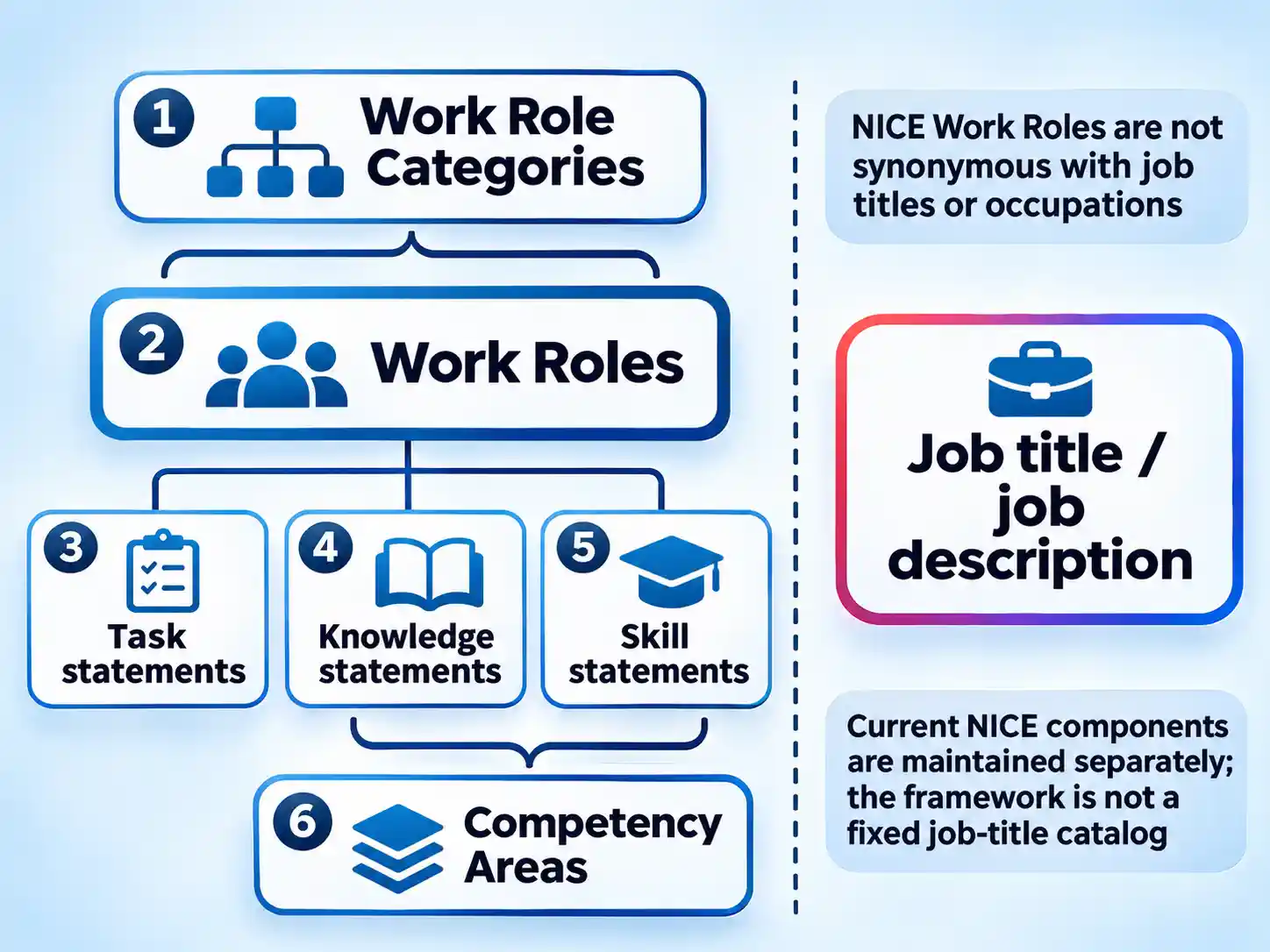
A cybersecurity role is an area of responsibility: a defined set of work someone is answerable for delivering. The NICE Workforce Framework for Cybersecurity formalizes this by calling a Work Role “a grouping of work for which someone is responsible or accountable,” while noting plainly that Work Roles are not synonymous with job titles or occupations. A Work Role Category, in the same framework, is a high-level grouping of common cybersecurity functions.
Info
A NICE Work Role describes accountable work. An employer’s job title describes whatever that employer decided to call the position. The two overlap often and match exactly almost never, which is why the same person can be an “Information Security Analyst” at one company and a “Cyber Risk Analyst” at another while doing similar work.
The practical consequence: when you evaluate a role, you are really evaluating a bundle. Who owns the alert queue? Who signs off on a firewall change? Who writes the incident report, and who presents it to leadership? Those answers describe the job far more accurately than the four words at the top of the listing.
How NICE turns work into a common language
NICE exists because the private sector, public agencies, and universities were describing the same work with incompatible words. The framework establishes a common lexicon that applies across public, private, and academic sectors, so a task described in one organization can be compared with a task described in another.
Its components fit together in a specific way. Work Role Categories group common cybersecurity functions. Work Roles sit inside those categories and describe accountable work. Each Work Role is associated with Task, Knowledge, and Skill statements: the discrete building blocks that describe what gets done and what a person needs in order to do it. Competency Areas then cluster related knowledge and skill statements around a capability.
Version currency matters here, because the framework’s data elements are maintained separately from the publication. NIST published SP 800-181 Rev. 1 in November 2020, superseding the 2017 edition, and a June 26, 2025 planning note directs readers to the NICE Framework Resource Center for current components: see the NIST publication record. Treat any fixed count of work roles you see quoted online as a snapshot rather than a permanent fact.
| Component | What it is | Question it helps you answer |
|---|---|---|
| Work Role Categories | High-level groupings of common cybersecurity functions | Which broad part of the security program does this job serve? |
| Work Roles | Groupings of work someone is responsible or accountable for | What accountable work would I own here? |
| Task statements | Discrete descriptions of work to be done | What would my actual week consist of? |
| Knowledge statements | What a person needs to know to perform the tasks | What background does this work assume? |
| Skill statements | What a person needs to be able to do | Which abilities would I be expected to demonstrate? |
| Competency Areas | Clusters of related knowledge and skill statements | How would my capability be assessed or developed? |
Common role families and the work they imply
Security work clusters into a handful of role families: analysis, engineering, investigation, testing, consulting, and leadership. Crossover is the norm rather than the exception: at many employers one person carries responsibilities drawn from two or three of these families at once, and the mix shifts with the size of the team. The table below describes what each family typically owns, so you can compare families rather than defend a title.
| Role family | Work it typically owns | Typical outputs |
|---|---|---|
| Security analyst | Monitoring and evaluating the security environment, identifying risks and suspicious activity, supporting controls and incident response, assessing whether protections work | Alert triage notes, risk findings, incident reports, control-effectiveness input |
| Security engineer | Designing, implementing, and maintaining technical security measures; assessing vulnerabilities; strengthening systems; supporting technical incident response | Configured controls, hardened systems, remediation changes, engineering documentation |
| Network security engineer | Protecting networks and transmitted data; monitoring network activity and vulnerabilities; implementing network controls | Firewall and segmentation configurations, network monitoring coverage, access-control changes |
| Security architect | Designing defenses into technology from the start, combining system knowledge with policy so protections are built in rather than added later | Reference architectures, design reviews, security requirements, standards |
| Security administrator | Day-to-day operation and maintenance of security systems and controls; managing access; applying updates; handling operational issues; supporting policy compliance | Access changes, patching records, tool administration, compliance evidence |
| Incident response and digital forensics | Responding to incidents and determining the appropriate response; examining devices and systems; preserving and analyzing digital evidence to establish what happened | Incident timelines, recorded response decisions, evidence records, post-incident findings |
| Penetration tester | Planning and conducting authorized tests, validating vulnerabilities, documenting findings, recommending improvements, retesting fixes | Test plans, findings reports with impact, prioritized remediation advice, retest results |
| Security consultant | Assessing a security environment, identifying risks and weaknesses, recommending measures, communicating findings to stakeholders | Assessments, roadmaps, risk summaries for non-technical audiences |
| Governance, legal, and privacy | Oversight and governance work providing leadership, management, direction and advocacy; cybersecurity legal advice; privacy compliance programs | Policies, risk registers, compliance assessments, legal guidance, privacy program decisions |
| Security manager and director | Overseeing teams and initiatives, setting policy and priorities, coordinating programs; directors supply senior leadership and strategy | Program plans, budgets, staffing decisions, executive reporting, strategy |
Notice what the table omits: pay. Compensation varies with experience, industry, geography, skill, and economic conditions, and published projections do not guarantee individual outcomes. Comparing families on compensation before you understand the work is the fastest way to end up in a job whose daily tasks you dislike.
Offensive work deserves a specific caution. Penetration testing centers on planning and conducting authorized penetration tests: scoping the engagement, testing systems and applications for exploitable weaknesses, documenting findings with recommended fixes, and retesting to confirm the fixes hold. Authorization is the defining feature of the job. Recruiters sometimes advertise the same work under the broader label Ethical Hackers, and that wording change affects the marketing far more than it affects the permission you need before touching a system you do not own.
Similar titles, different center of gravity
Adjacent role families share vocabulary, which is why postings blur together. The distinguishing question is where the work sits at the end of the week: what exists because that person did their job? That is exactly why task-and-responsibility taxonomies define roles by what someone owns rather than by the title printed on the org chart.
| Pair | Side A typically owns | Side B typically owns | How to tell them apart |
|---|---|---|---|
| Analyst vs. engineer | Observing and assessing: monitoring activity, identifying risk, judging whether controls work | Building and changing: designing, implementing, and maintaining technical controls | Does the posting ask what you would detect and assess, or what you would deploy and maintain? |
| Incident response vs. forensics | Response decisions while an event is active or just resolved | Evidence recovery and analysis to establish what happened and how | Is the deliverable a live response decision, or a documented reconstruction? |
| Governance and legal vs. security management | Policy, risk, regulatory interpretation, privacy obligations, legal advice | Operational leadership of teams, programs, priorities, and budgets | Does the role answer “what are we allowed and required to do?” or “who does it, when, and with what resources?” |
| Architect vs. administrator | Design decisions that shape how defenses are built into systems | Operation of existing controls: access, updates, configuration, issues | Are you approving a design, or keeping a running system inside its policy envelope? |
Effective incident response is a complex capability rather than a reflex: it requires substantial planning, dedicated resources, and documented analysis behind each response decision (NIST SP 800-61 Rev. 2). A role that owns response decisions therefore carries operational weight that a monitoring role does not, and postings rarely state that difference in plain language.
Compare two postings by stripping the titles and reading the work
Pull two postings that both sound plausible for you: ideally one from a large employer and one from a smaller organization, since scope diverges sharply between them. Work through the steps on both documents side by side.
- Remove the title from each posting. Copy the responsibilities into a separate document with the job title, company name, and seniority words deleted. You should be reading two lists of duties with no labels attached.
- List every task and the output it produces. Write each duty as a verb plus a deliverable: “triage alerts and write escalation notes,” “maintain access records,” “ExampleCo reports.” If a duty has no visible output, mark it as unclear; that gap is itself a finding.
- Map each list to a work area. Ask which broad function the majority of duties serve: monitoring and assessment, building and engineering, investigation, testing, consulting, or governance and leadership. The majority tells you what the job mostly is; the minority tells you what it occasionally absorbs.
- Check authority and scope. Look for words that assign decision rights: approves, owns, authorizes, signs off, escalates, advises. A posting that lists testing duties without stating who authorizes the testing has left the most important boundary undefined.
- Compare organizational context. Note employer size, team structure, and whether the role reports into security, IT, legal, or the business. Scope follows employer size and resources: a smaller or mid-size firm may need a generalist covering several areas, while a larger firm is more likely to have specialists. The same title at those two employers can mean different jobs.
- Resolve the ambiguous duties in conversation. Take your unclear items into the interview and ask what recent work the role owned, who else touched it, and what the last person in the seat delivered. Answers about specific past work are far more informative than restated job descriptions.
Verify the result
- You can state, in one sentence each, what work each posting would have you own and what you would hand over.
- You have identified which posting grants clearer decision authority and which leaves it unstated.
- You know which duties are core to the role and which are occasional overflow from a neighboring team.
- Your remaining unknowns are written as questions you can ask a hiring manager, not assumptions you have filled in yourself.
A worked comparison: one title, two different jobs
Here is how the method plays out. Two fictional postings both read “Security Engineer.” Acme is a 180-person software company with a two-person security team. ExampleCo is a bank with a forty-person security department.
- Acme, stripped of the title: build cloud guardrails, triage the alert queue two mornings a week, own the endpoint tool, answer audit questions once a quarter. Outputs are infrastructure changes and triage notes. You choose tooling inside a budget and escalate incidents upward.
- ExampleCo, stripped of the title: own firewall and segmentation change requests, review network designs, sit on the change advisory board, and hand detection tuning to a separate operations team. Outputs are approved change records and design reviews. You approve or block network changes.
Same three words at the top of the listing. Acme’s role is engineering with analyst overflow bolted on; ExampleCo’s is engineering with governance authority attached. One hands you build work and a shared alert queue, the other hands you a decision gate other teams must pass through. Neither is the better job in the abstract, but only one of them matches a week you would actually enjoy, and the posting titles alone could never tell you which.
When a posting is vague, hybrid, or inflated
Some listings resist the method above because they were written loosely, assembled from a template, or deliberately padded. These are the patterns worth recognizing before you spend interview time on them.
The responsibilities section lists qualities instead of work
“Detail-oriented self-starter with a passion for security” describes a personality, not a job. Look for any sentence naming a system, a process, or a deliverable. If none exist across the whole posting, ask the recruiter for the three tasks the role performed last quarter before you invest further.
The role spans monitoring, engineering, and compliance at once
This is common at smaller organizations, where one person covers ground a larger employer splits across a team. Ask what proportion of the week goes to each area and who covers the others during leave. A hybrid role can be excellent experience; it becomes a problem when the workload assumes three full-time people.
The seniority language does not match the duties
A “senior” title attached to ticket handling and no design or decision authority signals title inflation. Check whether the role approves anything, mentors anyone, or owns an outcome. If the answer is no across all three, the title is a compensation and recruiting device rather than a description of scope.
The posting never mentions on-call or incident duty
Any role touching detection or response carries some escalation expectation. Ask directly about on-call rotation, escalation paths, and what the team does when an incident crosses shifts. Silence in the posting does not mean the duty is absent.
The title does not map to any work area you recognize
Unusual titles are normal. Titles and responsibilities overlap constantly and get customized to organization size and needs, and roles evolve as the field changes. Compare the duties against a work area, then ask whether the title is standardized internally or invented for this hire.
Limits, misconceptions, and safety boundaries
Cybersecurity careers attract a particular set of assumptions that survive contact with real job postings. Correcting them early saves months of misdirected preparation.
| Common belief | What the work actually looks like |
|---|---|
| “A job title tells you what someone does.” | A title is an employer convention. The work itself is a bundle of tasks and outputs, and one job often spans several role areas. |
| “Real cybersecurity work is all hands-on technical.” | Governance, legal advice, privacy compliance, policy, and leadership are core security work, and they often carry more decision authority than hands-on technical roles do. |
| “Penetration testing means you are allowed to hack.” | Penetration testing is authorized testing. Permission comes from the system owner through a defined engagement, not from a job title. |
| “Incident response can be improvised by whoever is available.” | Effective incident response is a complex capability requiring dedicated planning and resources, with documented analysis behind each response decision. |
| “One certification or degree decides the role you get.” | Certifications and degrees show up as employer preferences. They are not universal licenses to practise, and they do not guarantee a job offer. |
Warning
Reading about a role grants no authority to act. Do not probe, scan, monitor, or access systems you do not own or have written permission to test. If you suspect a live security incident at your organization, follow your employer’s incident-response process and contact the designated internal security team rather than investigating on your own.
A practical fit decision
Role families are a useful starting filter, and a poor substitute for a personality test. Use them to generate questions about the work you want, then let real postings correct your assumptions.
- Do you want to assess or to build? Analysis work centers on judgment about what is happening; engineering and architecture work centers on what gets constructed and maintained.
- Do you want to investigate or to advise? Forensics and response work traces events during or after an incident; consulting work translates findings into recommendations for people who will act on them.
- Do you want to decide or to enable decisions? Management and director roles own teams, budgets, and priorities; governance, legal, and privacy roles shape what the organization is permitted and required to do.
- How much operational interruption can you absorb? Detection and response work frequently involves escalation outside standard hours; design, governance, and program roles generally follow a more predictable rhythm.
- What organizational size suits you? Smaller employers offer breadth and generalist experience; larger ones offer specialization and clearer boundaries between teams.
Key Takeaways
- Read every posting as a list of tasks, outputs, and decision rights before you read the title.
- Use the NICE Framework as a shared vocabulary for describing work, and expect employer titles to diverge from it.
- In interviews, ask for a specific recent deliverable; vague answers about duties are a reliable warning sign.
- Confirm who authorizes testing and who owns incident escalation before accepting any offensive or response-oriented role.
- Treat compensation, demand, and credential claims as variables that depend on your region and market, and verify them locally.
Read the work, not the label
The most reliable career move in cybersecurity is also the least glamorous: learn to read the labor. A title tells you what a company decided to call a job. The tasks tell you what your Tuesday looks like. The outputs tell you whether your work is visible. The authority tells you whether you can actually change anything. The organizational context tells you how much of the job exists only because of where it sits.
Take two postings this week, delete the titles, and run them through the same six steps. The comparison usually settles the decision faster than another list of job titles ever will. If location is part of your decision, our breakdown of cybersecurity career opportunities by city and country covers the regional context this role explainer leaves out.

💬 Comments